THE ILLUSION OF STILLNESS
How Your Eyes, Brain, and Muscles Make Thousands of Invisible Corrections to Keep You Standing
By Dr. Bomi Joseph, MD, PhD
The human body is never truly still. What we perceive as stability is the result of continuous, largely unconscious adjustments that keep us balanced, oriented, and ready to move.
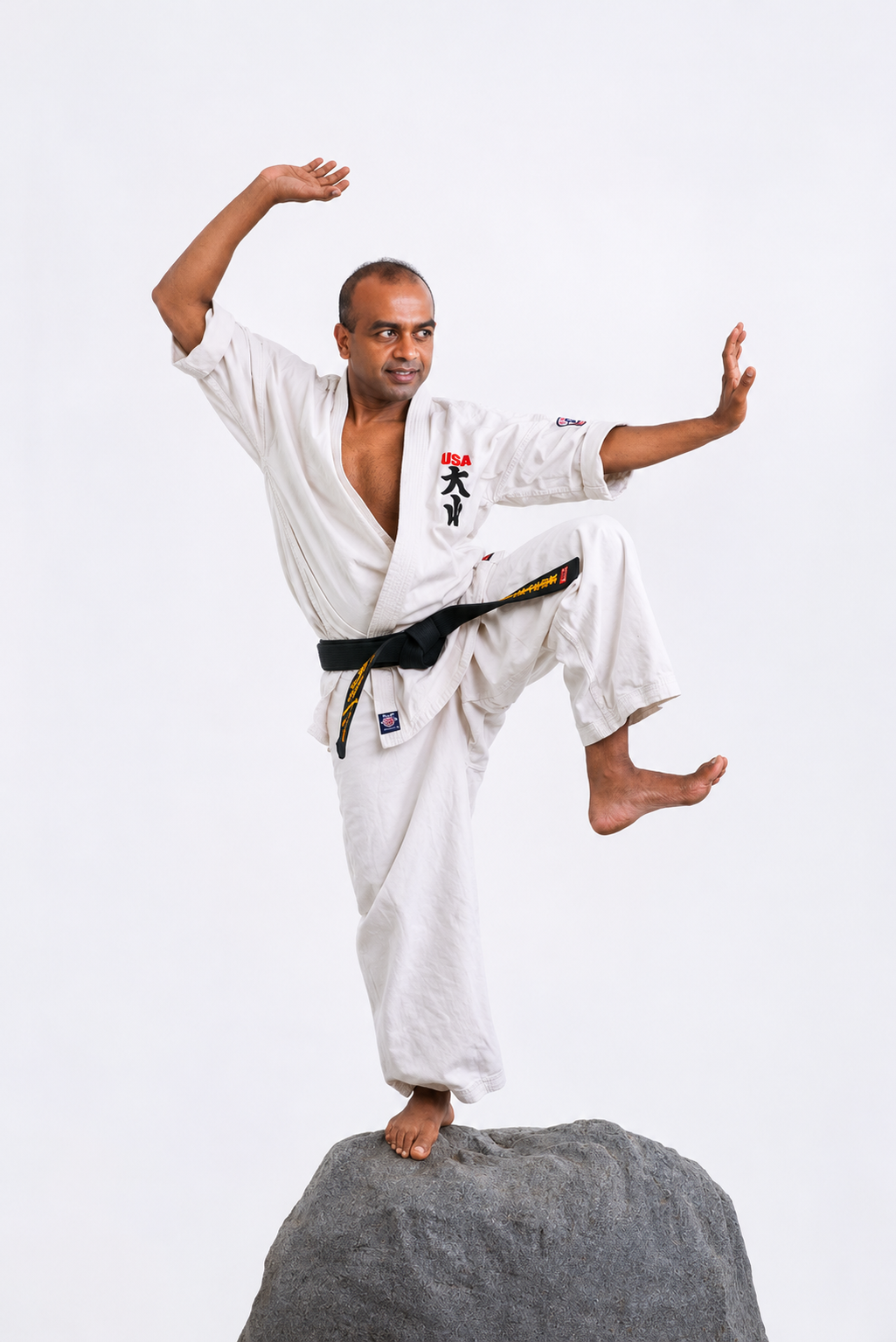
Dr. Bomi Joseph demonstrates controlled one-legged equilibrium in a Mas. Oyama Karate stance. The apparent stillness conceals continuous sensory integration and neuromuscular adjustment.
1. You Are Moving Even When You Think You Are Standing Still
Watch a highly trained martial artist standing motionless.
The feet appear firmly planted. The shoulders are relaxed. The head remains upright. The gaze is steady.
Nothing seems to move.
But beneath that apparent stillness, an extraordinary physiological process is taking place.
The body is continuously detecting tiny changes in position, interpreting sensory information, and activating muscles to maintain equilibrium.
The ankles adjust. The muscles of the feet change tension. The hips make small corrections. The trunk compensates. The head remains oriented toward the surrounding environment.
These movements can be extremely small, sometimes measured in millimeters, and generally occur without conscious awareness.
What appears to be a fixed position is actually a dynamic equilibrium.
2. The Eye Is More Than an Organ of Sight
We ordinarily think of the eyes as instruments for observing the world.
But vision also helps the nervous system determine where the body is in relation to its surroundings.
When the eyes fix on a stationary object, that object becomes a useful external spatial reference.
As the body sways, the relationship between the visual environment and the observer changes. Depending on the movement and viewing conditions, these changes produce visual signals that help the nervous system estimate body motion.
The brain uses this information alongside signals from the inner ear, muscles, tendons, joints, and skin.
The result is a continuously updated estimate of the body’s position and movement.
The eyes do not independently command every postural correction. Instead, visual information contributes to an integrated sensorimotor control system.
This distinction is important.
And the process continues.
3. The Human Body Is a Closed-Loop Control System
In engineering, a closed-loop control system continuously compares a desired condition with information about the actual condition.
When a deviation occurs, the controller initiates a response intended to reduce the error.
Human postural control follows a related principle, although biological control is more complex than a simple mechanical feedback controller.
Consider a person standing upright and looking at a fixed point.
A slight forward sway occurs.
Sensory receptors detect changes in body orientation, joint position, pressure distribution, and movement relative to the environment.
The central nervous system processes these signals and modifies muscular activation.
The resulting changes in muscle force alter body movement, producing new sensory information.
The cycle continues.
This is not an occasional correction made when someone is about to fall.
It is an ongoing physiological activity.
Moreover, the nervous system does not rely exclusively on detecting errors after they occur. It also uses predictive control, anticipating the consequences of movement and preparing appropriate muscular responses.
Human balance therefore involves both feedback and feedforward mechanisms.
4. Three Sensory Systems, One Coordinated Response
Three major sensory systems contribute to human postural stability.
Vision. The visual system provides information about the body’s movement and orientation relative to the surrounding environment. A stable visual reference can improve postural control, particularly during quiet standing.
Vestibular function. The vestibular organs of the inner ear detect head rotation, linear acceleration, and orientation relative to gravity. They are particularly important during head movement and when visual information becomes unreliable or unavailable.
Somatosensation and proprioception. Sensory receptors in the muscles, tendons, joints, and skin provide information about body configuration, muscle activity, and contact with supporting surfaces. During ordinary standing on a firm surface, somatosensory information is especially important.
The nervous system continuously integrates and reweights these sources of information according to their reliability.
Close the eyes, and visual information disappears. Balance remains possible because vestibular and somatosensory systems continue functioning.
Stand on an unstable surface, and the nervous system must adapt to less reliable information from the feet and ankles.
This capacity to reorganize sensory contributions is fundamental to human movement.
5. Why the Body Sways Even in Perfectly Quiet Standing
The upright human body is mechanically challenging to stabilize.
Its center of mass is elevated above a relatively small base of support.
Gravity continuously creates conditions that require muscular control.
During quiet standing, the body commonly behaves approximately like an inverted pendulum, with small movements occurring around the ankle joints.
But the body is not a rigid pendulum.
Multiple joints, muscles, sensory pathways, and neural control mechanisms participate in maintaining equilibrium.
The center of pressure beneath the feet continually changes as muscular forces redistribute loading against the ground.
These changes can be measured using force platforms.
Even when a person’s posture appears unchanged, the center of pressure may trace a continuously moving path.
Importantly, center-of-pressure movement is not identical to center-of-mass movement. The former reflects the forces used to control posture; the latter describes the movement of the body’s mass.
Both help explain the dynamics of balance.
6. The Quiet Eye: Useful, but Only Part of the Story
Sports science has extensively studied a phenomenon known as the Quiet Eye.
Research associated with Joan Vickers describes the final visual fixation or tracking gaze before a critical movement.
In activities such as shooting, golf putting, and basketball, expert performers often demonstrate gaze behaviors that differ from those of less experienced participants.
Longer or more appropriately timed final fixations have been associated with improved performance in various tasks.
But this phenomenon should not be confused with the entire physiological system responsible for maintaining balance.
Quiet Eye research primarily concerns visual attention, perceptual processing, and preparation for skilled movement.
Postural control concerns the continuous regulation of body orientation and equilibrium.
The two interact.
A stable gaze may support the acquisition of useful visual information. Appropriate postural control may help the athlete maintain the conditions required for precise visual fixation and movement.
Neither process operates in complete isolation.
The important question is not merely where the athlete looks.
It is how the athlete’s nervous system coordinates visual information, body position, muscular control, and movement.
7. The Martial Artist Understands What the Observer Cannot See
In Kyokushin Karate, stability is not simply the ability to remain standing.
It is the ability to maintain balance while preserving the capacity to respond immediately.
A rigid body may appear stable but be poorly prepared to adapt to an unexpected disturbance.
A trained martial artist seeks something different: controlled readiness.
Consider a fighter maintaining a stance while observing an opponent.
The feet provide a base of support. The lower limbs regulate muscular tension. The trunk coordinates posture. The head and eyes remain oriented toward relevant information.
The fighter is not waiting passively.
Sensory information is being processed continuously.
When the opponent moves, the fighter must interpret the movement, maintain equilibrium, and produce an appropriate response.
Visual fixation can help organize attention, but effective fighting also requires peripheral awareness, anticipation, proprioception, and rapid motor adaptation.
The objective is not to eliminate movement.
It is to control movement so effectively that unnecessary disturbances do not compromise the next action.
8. Stability Is Not the Same as Rigidity
This distinction extends well beyond martial arts.
A rigid structure resists deformation.
A living organism must do more.
It must detect disturbances, respond appropriately, and recover functional control.
Excessive muscular tension can interfere with efficient movement and adaptability. Conversely, insufficient muscular control may compromise stability.
The appropriate response depends on the task, environment, and magnitude of the disturbance.
A person standing quietly requires a different control strategy from someone walking across uneven ground, landing after a jump, or absorbing an opponent’s force.
Human postural control is therefore not directed toward one universally ideal degree of stillness.
It is directed toward maintaining functional stability under changing conditions.
A useful definition of physical stability is the capacity to preserve or recover controlled orientation despite disturbances.
That makes stability an active biological capability rather than a static position.
9. What Happens When the Feedback System Deteriorates?
The importance of sensory feedback becomes especially evident when one or more components are impaired.
Visual deterioration may reduce access to reliable spatial references.
Vestibular dysfunction may interfere with the detection of head motion and orientation.
Peripheral neuropathy may compromise sensory information from the feet.
Reduced muscular strength, impaired coordination, delayed responses, or neurological dysfunction can further affect postural control.
These changes do not necessarily produce an immediate inability to stand.
Instead, the nervous system may compensate by relying more heavily on the remaining sensory systems.
But compensation has limits.
A person may stand comfortably in a brightly illuminated room on a firm floor yet become unstable in darkness or on an uneven surface.
The difference is not simply muscular strength.
It is the availability, integration, and effective use of sensory information.
This is why balance assessment should examine how a person responds to changing conditions, rather than relying exclusively on whether the person can stand still for a specified duration.
10. The Deeper Principle: Health Is the Capacity to Respond
The physiology of balance illustrates a broader principle of human health.
A stable biological condition is not necessarily a condition in which nothing changes.
Living systems constantly encounter disturbances.
Body temperature changes. Blood pressure fluctuates. Energy requirements shift. Muscles fatigue. Environmental conditions change.
The body must detect these disturbances and organize appropriate responses.
In postural control, the disturbance may be a few millimeters of sway.
In other physiological systems, the disturbance may involve temperature, metabolic demand, fluid balance, or immune challenge.
The underlying regulatory mechanisms differ, but the broader principle remains relevant.
The ability to maintain equilibrium is one expression of that capacity.
A meaningful evaluation of functional health must therefore consider not only the condition observed at a particular moment, but also the person’s ability to respond when that condition changes.
A single observation of apparent stability reveals only part of the story.
The response to disturbance often reveals much more.
11. The Illusion of Stillness
Return to the martial artist standing quietly.
To an observer, nothing is happening.
But the nervous system is receiving information. Muscles are adjusting their activity. Forces beneath the feet are changing. The body is maintaining equilibrium through continuous regulation.
The apparent absence of movement conceals the activity that makes stability possible.
This is one of the remarkable characteristics of living systems.
Successful regulation often makes the underlying work invisible.
We notice balance when it fails.
We notice the correction when someone stumbles.
But the thousands of subtle adjustments that permit us to stand, walk, turn, and move through the world generally pass unnoticed.
The next time you see someone standing perfectly still, remember:
Scientific References
- Vickers, J. N. (2016). Origins and current issues in Quiet Eye research. Current Issues in Sport Science, 1, 101. doi:10.15203/CISS_2016.101
- Lebeau, J.-C., et al. (2016). Quiet Eye and Performance in Sport: A Meta-Analysis. Journal of Sport and Exercise Psychology, 38(5), 441–457. doi:10.1123/jsep.2015-0123
- Dalton, K. (2021). Review: The Quiet Eye in Sports Performance—Is the Quiet Eye the Ultimate Explanation or Only the Beginning? Optometry and Vision Science, 98(7), 732–737. doi:10.1097/OPX.0000000000001728
- Rienhoff, R., et al. (2016). The “Quiet Eye” and Motor Performance: A Systematic Review Based on Newell’s Constraints-Led Model. Sports Medicine, 46, 589–603. doi:10.1007/s40279-015-0442-4
- Proprioceptive, visual and vestibular thresholds for the perception of sway during standing in humans. Journal of Physiology. PubMed Central
- The role of vestibular cues in postural sway. Journal of Neurophysiology (2021). PubMed Central
- Neurosensory Integration and Balance Adaptation: Personalization of Postural Control Through the Prism of Individual Spatial Perception. Life (2026), 16(7), 1125. PubMed