

The Mineral Spectrum: From Macro-Minerals to Ultra-Trace Elements
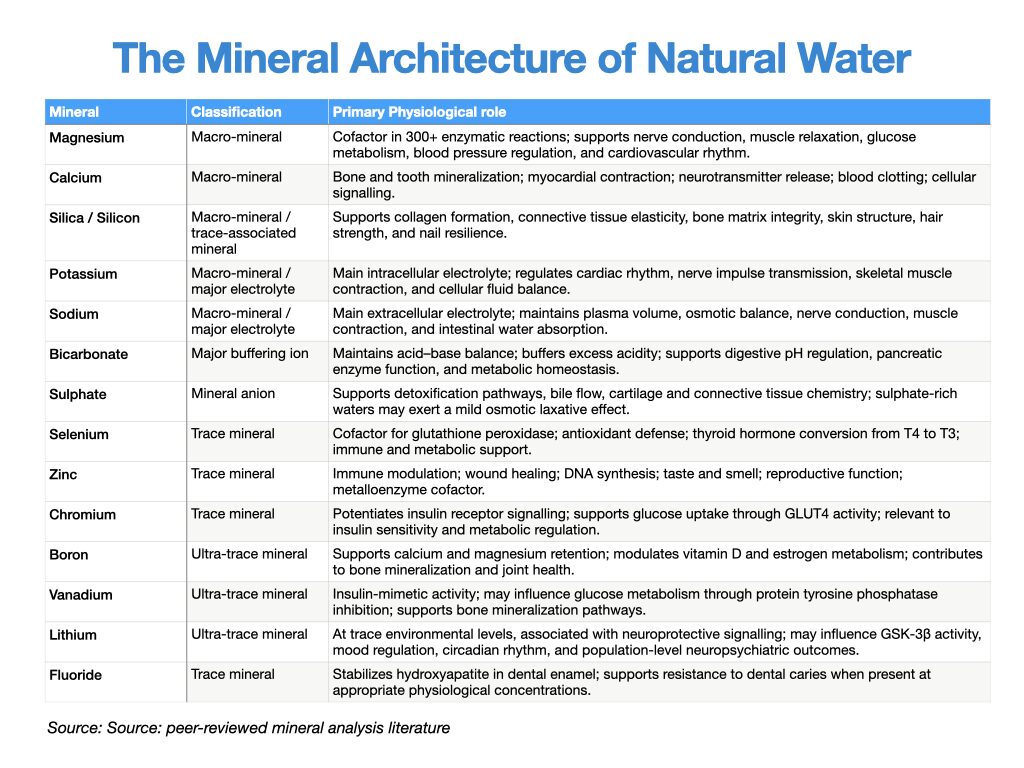
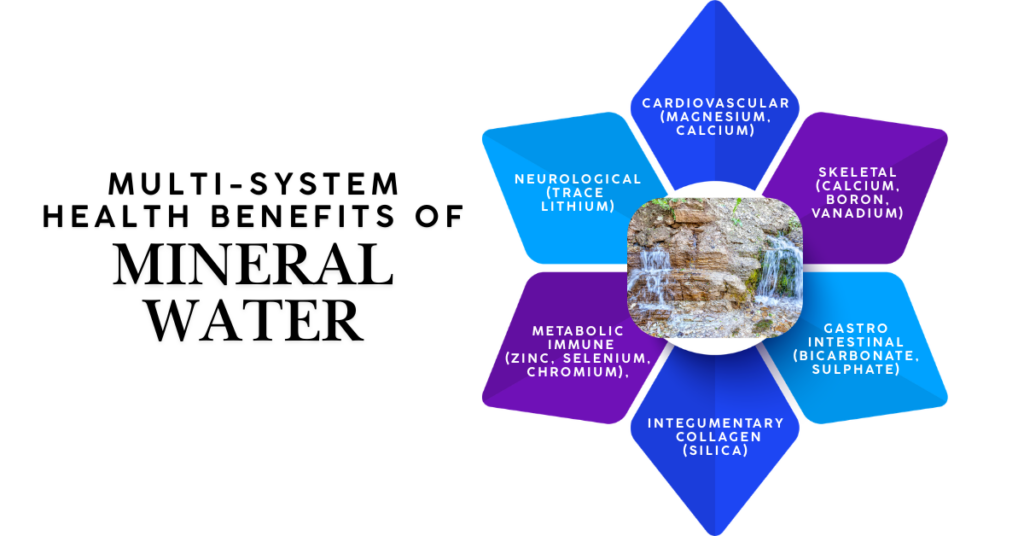
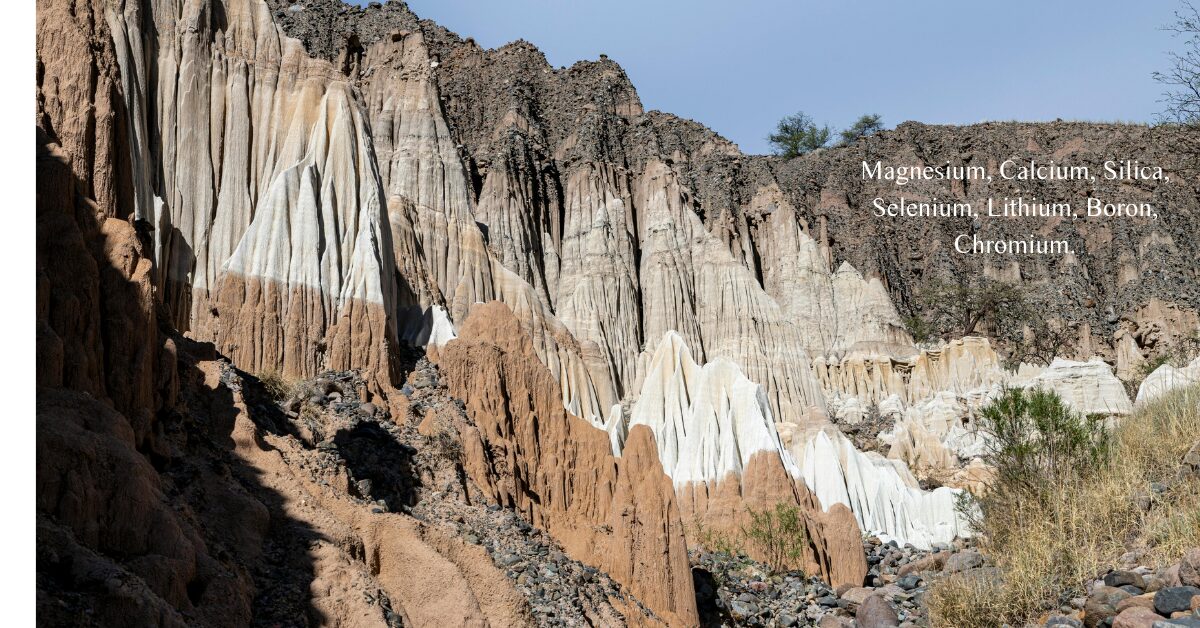
The mineral profile of natural water is geographically determined. European volcanic spring water differs markedly from North American limestone aquifer water, which in turn differs from springs emerging through ancient granite formations. What all uncontaminated natural sources share is a spectrum of dissolved elements spanning three tiers:
Lithium — commonly associated with pharmacological doses used in bipolar disorder — occurs naturally in certain spring waters at sub-therapeutic but biologically active trace concentrations. Epidemiological data suggest that populations with higher naturally occurring lithium in drinking water demonstrate lower rates of suicide and mood disorders, an association with plausible neurobiological mechanisms involving inositol signalling pathways.
Silica — often dismissed as a geological curiosity — is increasingly recognised as essential to collagen cross-linking, with direct implications for skin elasticity, joint cartilage integrity, and bone matrix architecture.
The Contamination Reality
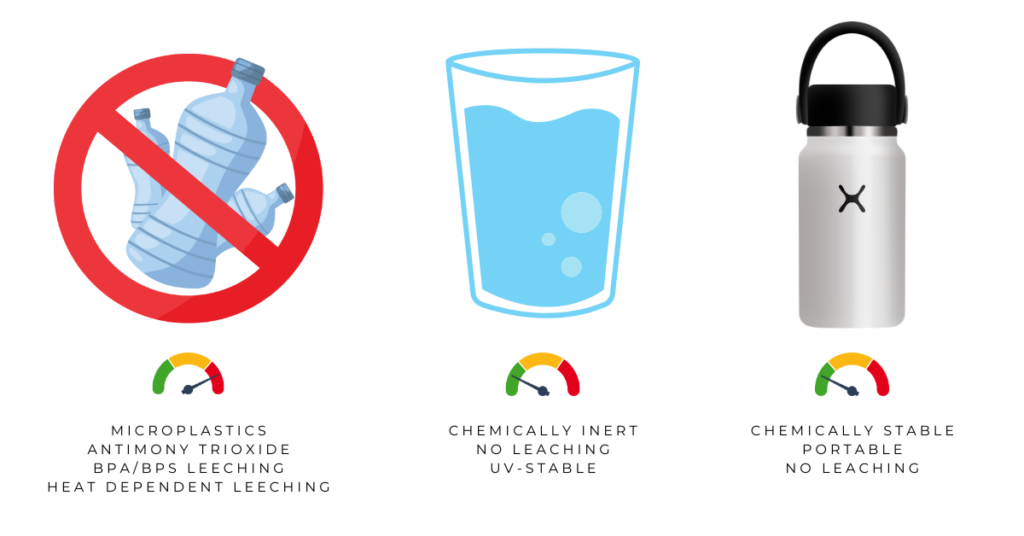
The argument in favour of natural water is immediately complicated by an inconvenient reality: over 20% of US drinking aquifers now contain measurable concentrations of PFAS (per- and polyfluoroalkyl substances), nitrates, heavy metals, or agricultural runoff. “Natural” is not synonymous with “safe.”
The goal, therefore, is not to reject processed water in favour of anything labelled “spring.” It is to identify verified, independently tested sources of natural spring water that preserve mineral integrity without carrying the toxic burden of modern environmental contamination.
Part I: The Chemistry of Water — Why H₂O Is an Oversimplification
Natural Water Is a Mineral Solution, Not a Pure Liquid
We tend to conceptualise water as a blank liquid — a neutral carrier distinguished only by its volume. That mental model is accurate for the distilled product of a laboratory still. It bears almost no relationship to the water that sustained human populations throughout the entirety of our evolutionary history.
Natural spring water and aquifer water are not pure H₂O. As groundwater migrates through successive geological strata — limestone, granite, volcanic basalt, sedimentary rock — it dissolves minerals and trace elements from those formations, incorporating them into solution as freely ionised particles. The resulting liquid is a low-concentration mineral solution, and it is precisely that dissolved mineral content that confers biological value beyond simple fluid volume.
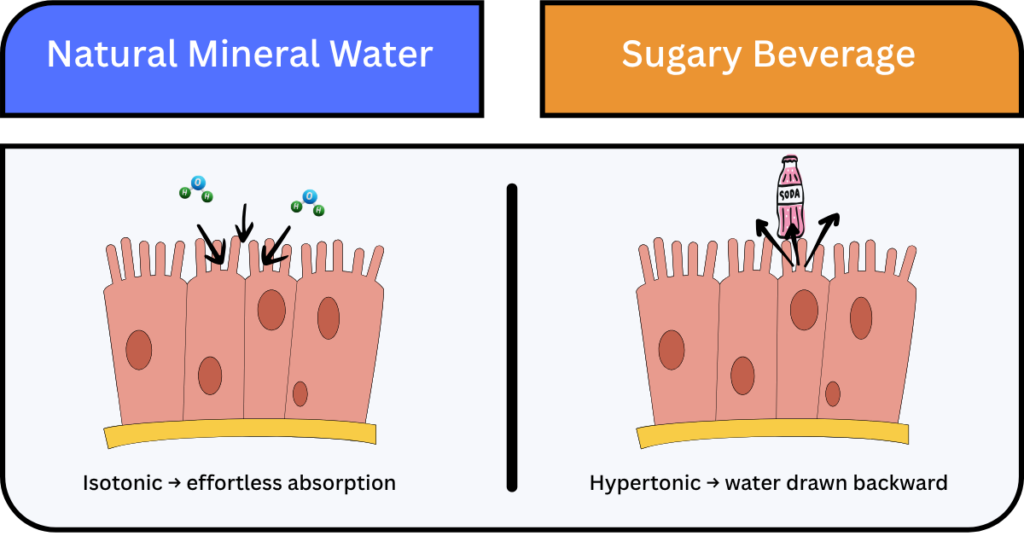
The critical distinction is bioavailability. Minerals dissolved in water exist in their ionic form — electrically charged, freely mobile, and ready for immediate cellular uptake. There is no digestive step required, no enzymatic conversion, no competition with dietary phytates or oxalates. Ionic magnesium in spring water crosses the intestinal epithelium and enters systemic circulation far more efficiently than the same element ingested as a tablet. This is why natural drinking water has historically served as a primary — if underappreciated — source of essential micronutrients.
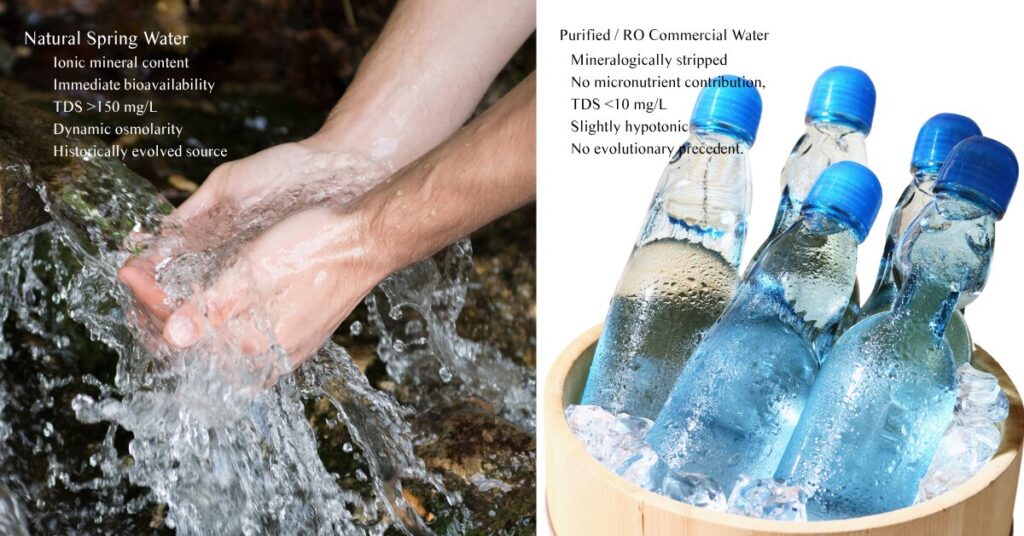
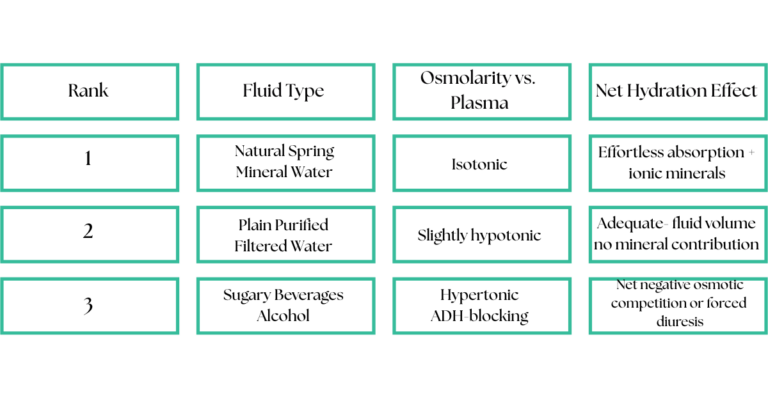
Natural Spring Water vs. Purified Commercial Water
The dominant paradigm in the commercial water industry treats purity as virtue. Reverse osmosis, deionisation, and distillation are marketed as superior because they remove contaminants. This framing is not wrong — they do remove contaminants, and that matters enormously in areas with compromised water supplies.
The problem is that these processes are mineralogically indiscriminate. They remove heavy metals and pharmaceutical residues. They also strip out every dissolved mineral with equal efficiency, leaving behind water that is chemically pure but nutritionally inert.
Reverse osmosis removes approximately 99% of dissolved solids. The resulting product provides fluid volume and nothing else. Furthermore, some research suggests that highly demineralised water consumed exclusively over long periods may increase urinary excretion of magnesium and calcium, potentially creating a net mineral deficit in susceptible individuals — a finding noted by the World Health Organization.
This does not mean purified water is harmful. It is a missed opportunity, and the distinction matters more the longer you consume it exclusively.