Biological-Age Clocks: The Same Error, Now Applied to Aging
Consider the expanding commercial industry surrounding biological-age testing.
DNA methylation clocks, glycan-based age estimates, proteomic clocks, and other molecular algorithms measure patterns associated with chronological age or particular health outcomes.
There is nothing inherently wrong with studying these patterns.
The problem arises when an age-associated measurement is marketed or interpreted as a direct measurement of biological aging itself.
An association with age is not a measurement of aging.
That distinction becomes particularly important when the underlying biomarkers change in response to ordinary physiological conditions.
Pregnancy provides an extraordinary example.
Researchers have reported that pregnancy increases estimates generated by certain epigenetic aging clocks. Following childbirth, some of those estimates decline. [5]
This has produced headlines suggesting that pregnancy accelerates biological aging and childbirth reverses it.
But consider what pregnancy actually involves.
During pregnancy, a woman's body undergoes profound hormonal, cardiovascular, immune, metabolic, and tissue-level adaptations.
These are coordinated physiological processes supporting pregnancy and fetal development.
The body's biology changes because the body's demands change.
After delivery, those demands change again. The molecular markers respond accordingly.
Yet when an algorithm trained on age-associated molecular patterns produces a different numerical output, that change can be interpreted as years of aging gained or lost.
What has actually been measured?
A change in the molecular state of the body. Not necessarily an irreversible change in the organism's biological age.
This is precisely the question I have been raising in my examination of biological-age claims, including those associated with pregnancy and postpartum recovery.
If a clock estimates that a woman has aged several years during pregnancy and subsequently become biologically younger after childbirth, the first question should concern the clock's sensitivity to physiological state.
Not whether pregnancy has somehow altered the passage of biological time.
A fluctuating algorithmic output does not, by itself, demonstrate accelerated aging or age reversal.
The same problem arises with glycan-based biological-age estimates.
Glycosylation patterns are responsive to immune activity, hormonal environments, nutrition, and other physiological influences.
If a glycan-age score changes following fasting, exercise, or hormonal transitions, the observation establishes that the measured molecular pattern has changed.
It does not automatically establish that the person has become biologically older or younger.
The algorithm changed its answer. That does not mean the organism changed its age.
Wearables: When an Inference Becomes a Biological Fact
The wearable technology industry has developed a commercial variation of the same scientific problem.
Devices collect optical, motion, temperature, and other peripheral signals.
Algorithms process those signals.
The resulting estimates are presented as sleep stages, recovery scores, readiness scores, stress levels, physiological age estimates, or cardiovascular indicators.
Here the critical distinction is between what is actually measured and what is inferred.
An optical sensor measures changes in reflected or transmitted light. An accelerometer measures movement. A peripheral temperature sensor measures temperature at its measurement site.
These are real physical observations.
But sleep architecture, autonomic regulation, cardiovascular performance, and integrated physiological recovery are substantially more complex phenomena.
They cannot simply be equated with a proprietary algorithm's interpretation of a few peripheral signals.
Take sleep.
A person sleeps peacefully for eight hours and wakes refreshed. Their wearable reports insufficient deep sleep. The person now worries that their sleep was poor.
Another person wakes exhausted, yet the wearable reports an excellent sleep score.
Which should the person believe?
I have argued for years that the body possesses its own extraordinary systems for detecting physiological conditions and regulating responses.
Modern consumer technology increasingly invites people to distrust those systems in favor of algorithmic estimates.
The problem becomes particularly concerning when a score is interpreted as a diagnosis, a direct measure of health, or proof that an intervention has improved biological function.
An algorithmic estimate of recovery is not recovery itself.
And a change in a recovery score is not necessarily an improvement in physiological capacity.
The same distinction applies to cuffless blood-pressure technologies.
Blood pressure is a physical quantity. A wearable that estimates blood pressure from optical waveforms is operating through an inferential chain involving measurement, signal processing, calibration, and statistical modeling.
Each stage introduces assumptions and potential errors. Those assumptions must be independently validated against appropriate reference methods. [6]
The fact that an algorithm produces a plausible number does not establish that it has accurately measured the underlying physiological quantity.
Measurement is not inference. Inference is not validation. And validation against one endpoint is not validation of every health claim built upon it.
This is the distinction at the heart of my long-running examination of Oura, WHOOP, and the broader wearable industry.
The Second Cardiovascular Failure: Novartis and Lipoprotein(a)
On the same day that the ZEUS findings drew attention, another major cardiovascular trial reinforced the need for caution.
Novartis and Ionis developed pelacarsen to reduce lipoprotein(a), or Lp(a), a genetically influenced cardiovascular risk factor.
The rationale was supported by substantial epidemiological and genetic evidence associating elevated Lp(a) with cardiovascular disease.
The drug lowered Lp(a) by approximately 78%.
An enormous change.
But in a trial involving more than 8,300 patients, that reduction did not translate into the expected reduction in major cardiovascular events over a median follow-up of 4.7 years. [7]
Once again, an impressive biomarker change failed to deliver the anticipated clinical benefit.
To be clear, a negative result with one drug does not disprove every proposed causal role of Lp(a). Nor does a negative IL-6 trial disprove every contribution of inflammation to atherosclerosis.
But both trials expose the danger of assuming that changing a disease-associated variable will necessarily improve the disease.
Biomarker success is not clinical success.
And it is clinical success that ultimately matters to patients.
Why Does Medicine Keep Making This Mistake?
Part of the explanation lies in the way biomedical research is organized.
Modern research frequently isolates individual biological pathways.
One laboratory studies an inflammatory cytokine. Another studies DNA methylation. Another studies circulating proteins. Another studies optical pulse signals.
Each laboratory may develop sophisticated methods for measuring its chosen variable.
The results are statistically analyzed, published, replicated, and eventually commercialized.
But the human organism does not operate as a series of independent laboratory experiments.
It operates as an integrated biological system.
An inflammatory response does not exist independently of metabolism, immunity, vascular function, neural regulation, and tissue repair.
A molecular aging marker does not exist independently of hormonal conditions, nutritional status, immune activity, and cellular adaptation.
A sleep-stage estimate does not exist independently of the measurement technology and the physiological assumptions underlying its algorithm.
The body is integrated. The research is fragmented.
This creates fertile ground for mistaking a measurable fragment of physiology for the biological process itself.
There is also a powerful commercial incentive.
A measurable variable offers an attractive product-development target. It can be quantified. It can be graphed. It can be reduced or increased.
It can be incorporated into a clinical trial endpoint or displayed on a smartphone.
A company can tell investors that its drug reduced a biomarker by 70%.
A longevity clinic can tell customers that its intervention reduced their biological-age estimate by five years.
A wearable company can tell subscribers that their recovery score improved by 15 points.
These are commercially compelling statements.
But they leave unanswered the most important question:
Did the person's actual biological health improve?
The Missing Measurement: Physiological Capacity
I have spent more than 40 years researching precisely this distinction.
My work with the Deep Health® Device and the development of the Deep Health Unit (DHU) framework grew from the recognition that health cannot be reduced to a collection of disease-associated measurements.
Health must be understood through the organism's functional capacity.
Can the body detect a physiological disturbance?
Can it generate an appropriate response?
Can it coordinate that response across interacting systems?
Can it recover efficiently and return to a stable functional state?
These are not the same questions as whether one inflammatory marker is elevated, one methylation clock has changed, or one wearable score has increased.
Two people may exhibit similar resting biomarker values while possessing substantially different capacities to respond to stress.
Conversely, a person undergoing an appropriate physiological adaptation may temporarily exhibit marked changes in biomarkers without experiencing a corresponding deterioration in health.
This is why I distinguish health from longevity.
Longevity is time. Health is capacity.
A biological-age algorithm attempting to compress complex physiological conditions into an age-equivalent number cannot automatically substitute for direct investigation of health capacity.
Similarly, treating the concentration of an inflammatory molecule cannot automatically substitute for restoring the physiological systems that are failing.
We need to study the organism, not simply the convenient variables we can extract from it. [8]
The Expensive Consequences of Reversing Cause and Effect
The consequences are not merely intellectual. They are financial, clinical, and institutional.
Developing a pharmaceutical intervention through late-stage clinical trials can require extraordinary resources.
Large trials enroll thousands of patients, involve numerous investigators and medical centers, and consume years of scientific effort.
When the underlying causal hypothesis is insufficiently established, those costs become a very expensive test of an assumption.
A failed trial can still produce valuable scientific knowledge.
Indeed, ZEUS has provided something exceptionally important: strong experimental evidence that substantial inhibition of this inflammatory pathway did not improve the specified cardiovascular outcomes in the population studied.
But it also raises a difficult question:
How much earlier could we have challenged the assumption that reducing these inflammatory markers would necessarily improve cardiovascular outcomes?
The same question should be asked of commercial biological-age tests, longevity interventions, and wearable health claims.
Before announcing that an intervention reverses aging, demonstrate that it changes an independently validated measure of biological aging.
Before claiming that a device measures recovery, establish that its output corresponds to independently measurable physiological recovery.
Before interpreting a biomarker change as a health improvement, demonstrate the improvement in health.
Do not use the same unvalidated inference to define the problem, measure the treatment, and declare the treatment successful.
That is circular reasoning dressed in sophisticated mathematics.
A Better Scientific Question
The greatest danger in modern biomedical research may not be that scientists measure too little.
It may be that they measure enormous amounts of data without sufficiently establishing what those measurements mean.
Artificial intelligence makes this problem potentially worse.
Algorithms can identify correlations across millions of observations. They can produce remarkably accurate predictions. They can discover patterns that human researchers would never recognize.
But predictive accuracy does not, by itself, establish causality.
An algorithm may identify a molecular signature that predicts disease. That does not mean the molecular signature causes the disease.
An algorithm may predict chronological age from DNA methylation. That does not mean reversing the methylation pattern reverses biological aging.
An algorithm may recognize optical signals associated with particular physiological conditions. That does not mean it directly measures those conditions.
A million correlations do not automatically add up to one causal explanation.
The crucial scientific task remains unchanged:
Determine what the body is doing, why it is doing it, and whether changing the measured variable changes the underlying biological outcome.
This requires more than increasingly sophisticated statistical models.
It requires experiments that distinguish cause from consequence, direct measurement from inference, and biological adaptation from pathology.
Conclusion: Stop Treating the Alarm. Investigate the Fire.
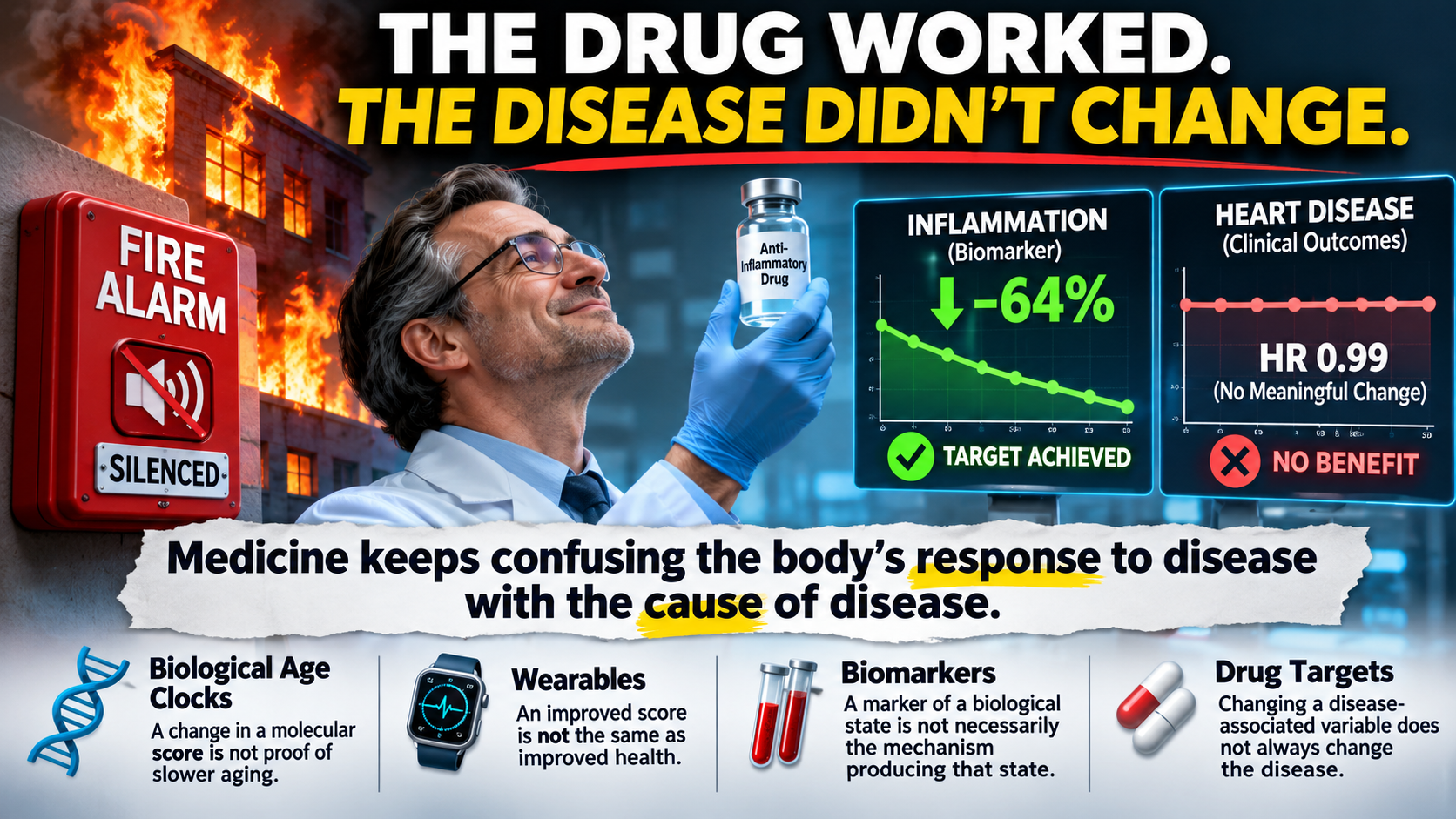
The ZEUS trial should become an important lesson in biomedical research.
The drug reduced inflammatory markers substantially. It did not reduce the cardiovascular events it was intended to prevent.
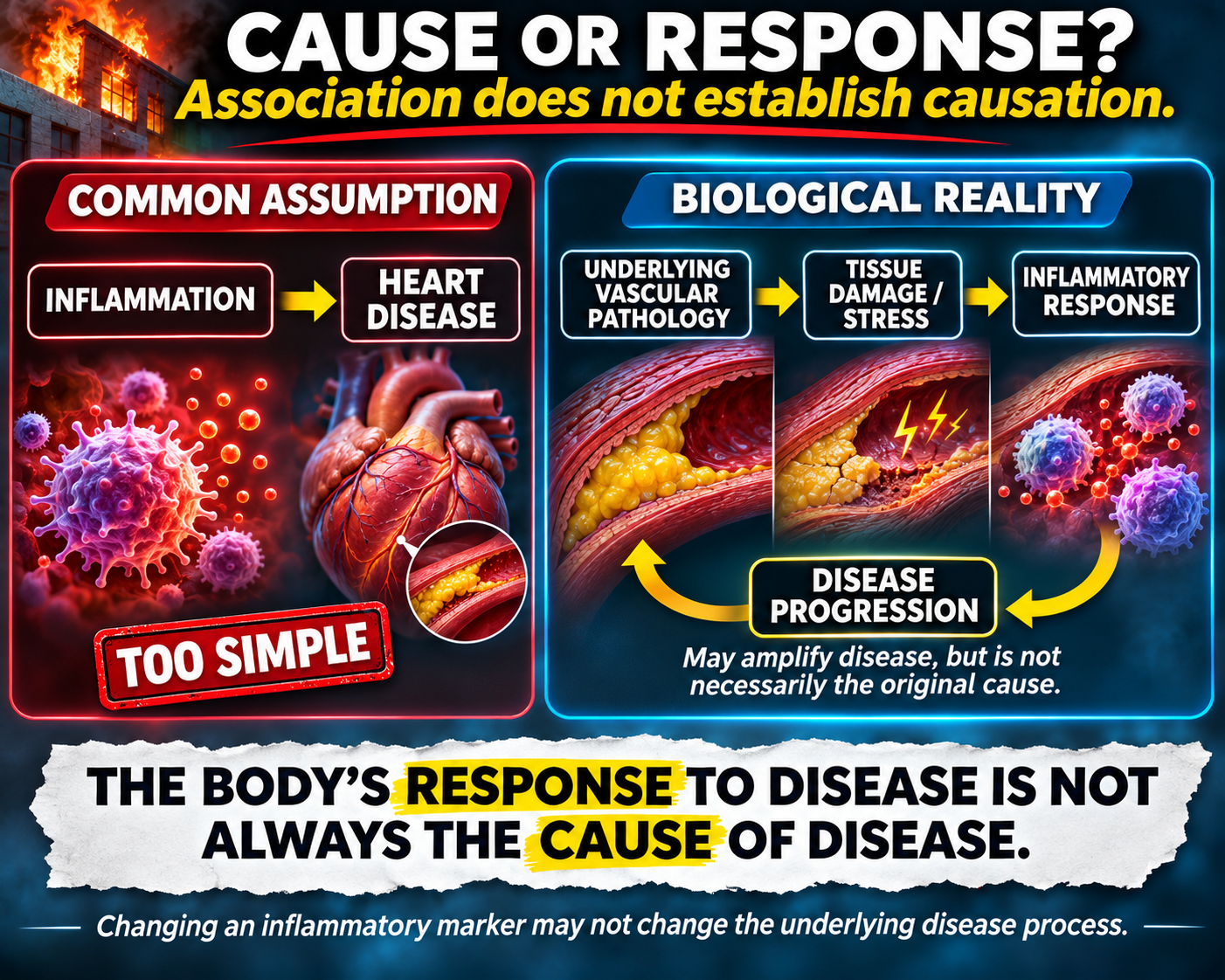
That result does not mean inflammation is irrelevant to cardiovascular disease. It means that manipulating one inflammatory pathway cannot be assumed to correct the broader disease process.
And the lesson extends far beyond cardiology.
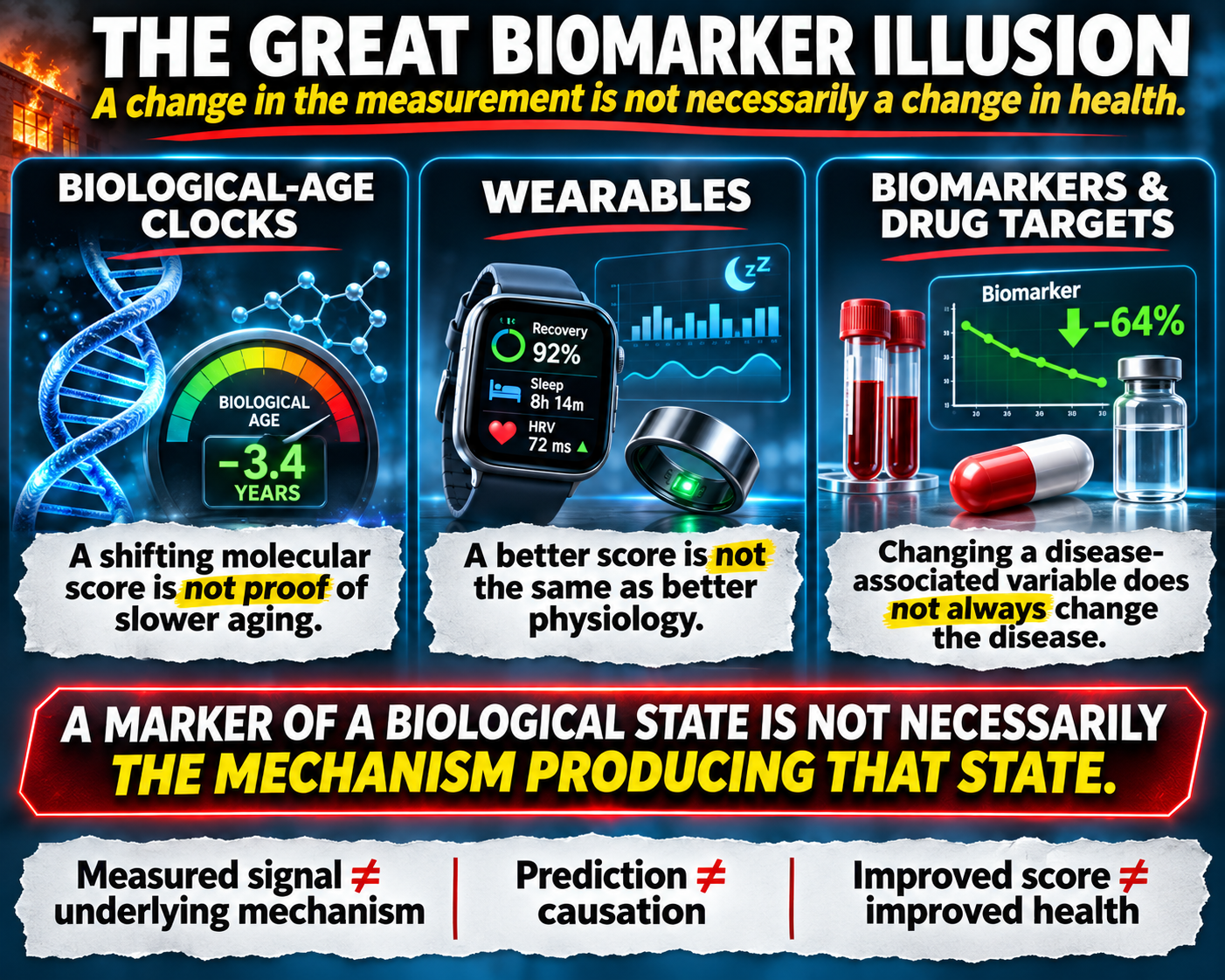
Biological-age clocks can change without proving that biological aging has changed.
Glycan profiles can shift without proving that an organism has become younger or older.
Wearable scores can improve without demonstrating that integrated physiological health has improved.
Biomarkers can predict disease without being its principal cause.
Medicine must become far more disciplined about distinguishing these different claims.
For decades, I have argued that understanding human health requires studying the coordinated biological systems that detect, respond to, and recover from physiological disturbances.
The body is not a collection of independent numbers.
It is a dynamic, interconnected organism.
A marker of a biological state is not necessarily the mechanism producing that state.
Until medicine takes that distinction seriously, we will continue to spend vast sums developing treatments for measurements, marketing changes in algorithms as changes in human biology, and confusing the body's responses to disease with the causes of disease.
The fire alarm is telling us something important.
But turning down the alarm is not the same as extinguishing the fire.
Dr. Bomi Joseph is a physician, health scientist, and inventor of the Deep Health® Device. His research focuses on measuring human health as integrated physiological capacity rather than merely the absence of disease.