
Harvard Medical School Must Answer for the Pregnancy Aging Narrative
When uncertain biomarker interpretations become authoritative public claims, women deserve answers.
By Bomi Joseph, MD, PhD
A Harvard Medical School affiliation does not turn a changing biomarker into proof that a woman has aged.
It does not establish that a second pregnancy leaves her permanently older. And it does not relieve researchers, journal editors, or institutional communications departments of the obligation to distinguish physiological adaptation from biological deterioration.
On October 26, 2026, Kai Weng and I published our critical review, Pregnancy-Associated Biomarker Changes Are Not Equivalent to Biological Aging. We examined the pregnancy-aging interpretation and independently analyzed the complete DunedinPACE records available in a disclosed trajectory workbook. [1]
Our scientific paper uses measured language. Here I want to state the public concern plainly: the evidence examined does not establish that pregnancy causes accelerated or cumulative biological aging. Common sense should establish that fact. Yet that interpretation is being promoted with the authority of Harvard-associated research, institutional publicity, and a major scientific publisher.
That deserves scrutiny well beyond a specialist journal.
Where is the evidence that these women actually aged
Pregnancy changes a woman's physiology. Hormones, immune activity, metabolism, circulation, and tissue demands change to support gestation and childbirth. Recovery brings further changes that are homeostatic.
A methylation-based algorithm may respond to those changes. That does not establish what the response means.
Before interpreting a higher score as accelerated aging, researchers must demonstrate that the score distinguishes pregnancy adaptation from the deterioration they claim to measure. Before describing postpartum normalization as rejuvenation, they must establish that biological aging actually occurred.
Calling an output “biological age” cannot settle that question. The label is part of the interpretation being tested.
Our objection is specific. The studies we examined do not establish the claimed connection between pregnancy-related clock changes and lasting biological deterioration. Pregnancy complications and long-term maternal health deserve serious investigation. They cannot supply missing validation for an aging algorithm by association.
Four biomarkers did not provide four confirmations
Etzel and colleagues' 2026 paper examined telomere length, GrimAge2, PhenoAge, and DunedinPACE. Its subsequent-pregnancy narrative needs to be assessed against the corresponding statistical results, rather than the impression created by an abstract or headline. [2]
Our review reported the following later-pregnancy-by-time interactions from the supplementary results:
| Biomarker | Reported interaction p value | Result |
|---|---|---|
| Telomere length | 0.191 | Not statistically significant |
| GrimAge2 | Approximately 0.14 | Not statistically significant |
| PhenoAge | Approximately 0.14 | Not statistically significant |
| DunedinPACE | 0.006 | Significant selected nonlinear interaction |
Three measures did not provide statistically significant corroboration of the corresponding interaction. One did.
Nonsignificance does not prove that an association is zero. But three nonsignificant findings cannot be presented as three confirmations of the same cumulative-aging story.
Nor does a significant result from the fourth measure establish permanent damage, lost years of life, or irreversible aging after a second pregnancy. Those conclusions require evidence beyond a statistical interaction in a biomarker model. So, we checked.
We examined the disclosed DunedinPACE records
The trajectory workbook contained 21 rows with DunedinPACE measurements at all three nominal visits. In those complete records, our restricted paired analysis found a prenatal-to-final mean change of −0.0089, with a 95 percent confidence interval from −0.1602 to +0.1425 and p = 0.904. [1]
We also identified a serious obstacle to independent verification: the reviewed workbook lacked the original participant identifiers, and its pregnancy indicators could not be mapped unambiguously to the published later-pregnancy classification.
Our comparison was not the same test as Etzel's adjusted nonlinear interaction. We therefore did not claim that p = 0.904 mathematically disproved p = 0.006. Our published paper explicitly makes that distinction.
What we found was no independent confirmation of sustained mean elevation in the complete records we could analyze, alongside unresolved traceability and model-reconstruction limitations.
More fundamentally, even successful replication of that interaction would leave the central biological question unanswered: what establishes that the changing score represents aging?
Poganik knows the distinction matters
Jesse R. Poganik is identified by an official Harvard-affiliated laboratory page as an Instructor in Medicine at Harvard Medical School and an investigator at Brigham and Women's Hospital. [3]
His 2023 paper interpreted stress-associated biomarker changes, including changes during pregnancy, within a biological-age increase-and-recovery framework. That paper predates Etzel's 2026 study; the chronology matters. [4]
In September 2026, Poganik and colleagues published Aging vs. biological age: Conceptual considerations for age reversal claims. It explicitly addresses the distinction between aging and biological age and the burden of proof for reversal claims. [5]
Then, in October 2026, Albright and Poganik published The postpartum recovery window as a determinant of maternal aging. The review advances the hypothesis that insufficient time between pregnancies could interrupt recovery and allow an aging burden to compound. [6]
In September 2026, Poganik and colleagues emphasized the distinction between aging and biological age, and the burden of proof required for reversal claims.
In October 2026, Albright and Poganik advanced a maternal-aging framework in which another pregnancy could interrupt recovery and allow an aging burden to accumulate.
Before discussing whether recovery from pregnancy-induced aging is complete, researchers must establish that the measured changes represent aging in the first place. Otherwise, the hypothesis assumes the very interpretation that requires validation.
Harvard Medical School and the journal editors should expect a clear answer. What changed in that month?
What independently validates those pregnancy-related clock movements as aging? What demonstrates persistent deterioration rather than a change in reproductive state? What establishes that another pregnancy compounds an aging burden?
A plausible hypothesis can justify a study. It cannot serve as the study's answer.
Watch what becomes certain in public
In the LinkedIn material accompanying our review of his communications, Poganik writes:
“Pregnancy temporarily accelerates biological age.”
The sentence presents the underlying aging interpretation as a fact. The uncertainty comes afterward, in the question of whether pregnancy spacing determines how fully recovery occurs.
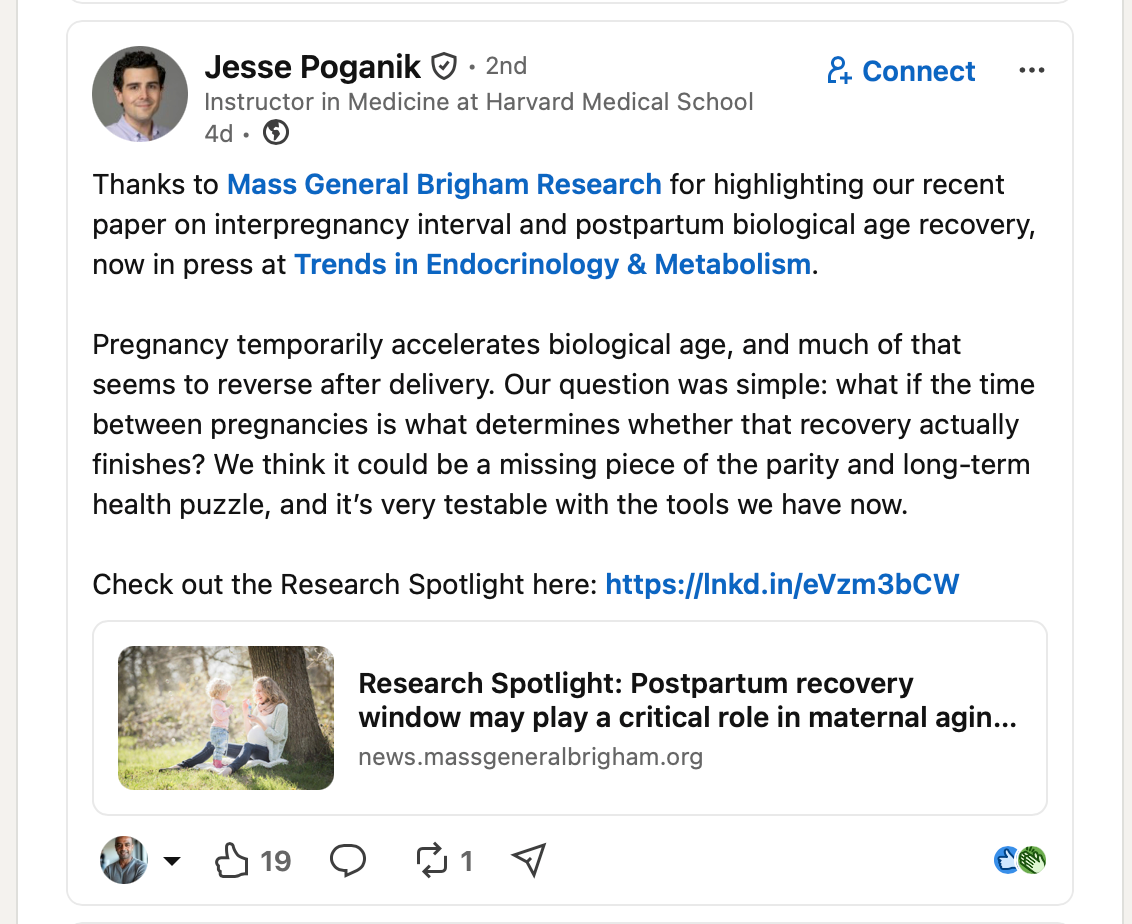
That is the gap I want examined. The proposed consequence is labeled a hypothesis, while the disputed premise is presented as established.
Mass General Brigham's own research spotlight follows a similar structure: pregnancy-related biological-age elevation is treated as a starting point, while the proposed lifelong effect of spacing remains a hypothesis. The spotlight also acknowledges that the connection to long-term outcomes is unresolved and that some pregnancy changes may be healthy adaptations. [7]
Those qualifications matter. They should shape the opening claim, rather than appear later as qualifications readers must reconcile for themselves.
The Cell Press news release likewise acknowledges that the changes do not necessarily represent biological damage and that studies following mothers for decades would be needed to support aging-based recommendations. [8]
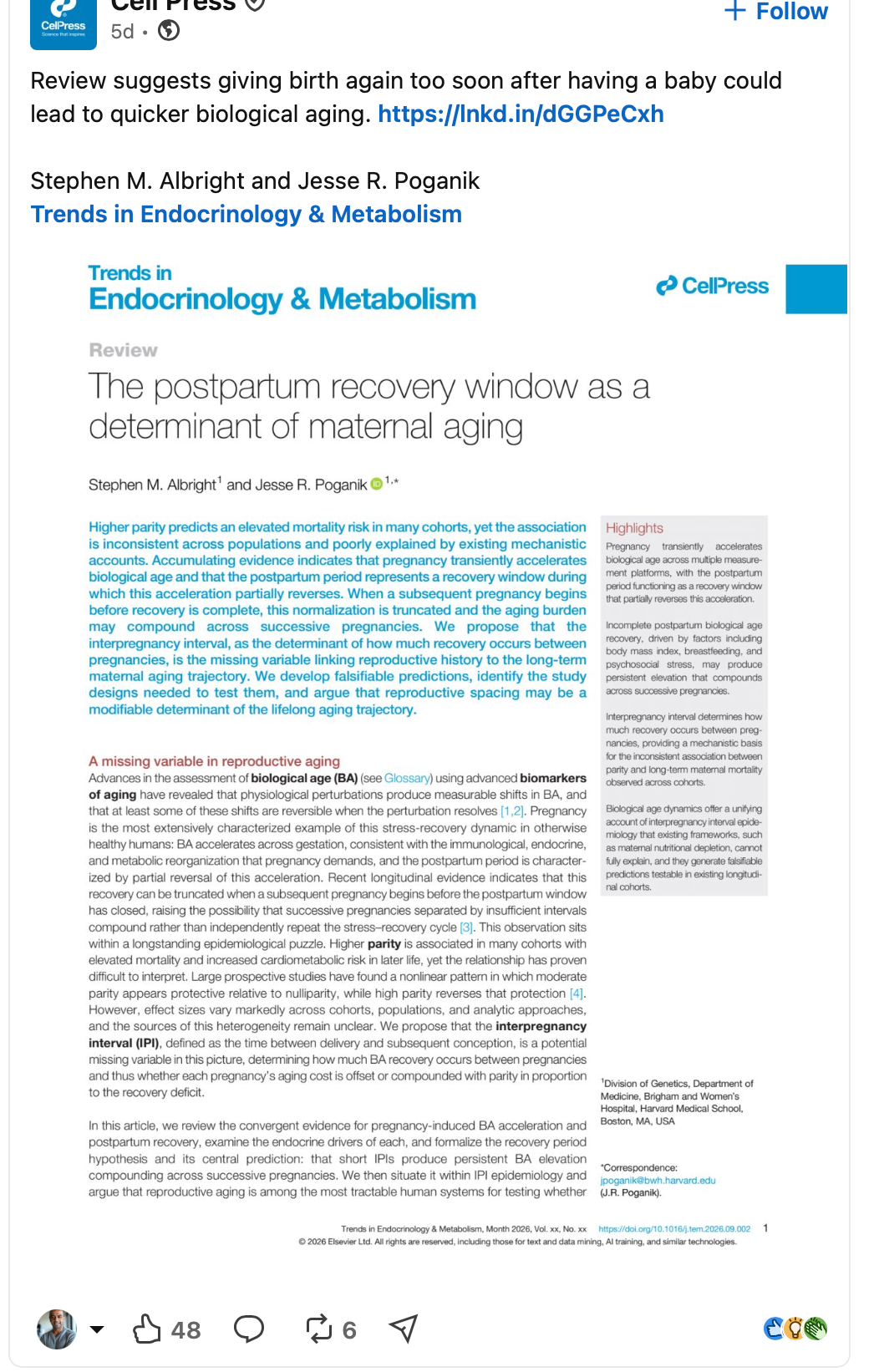
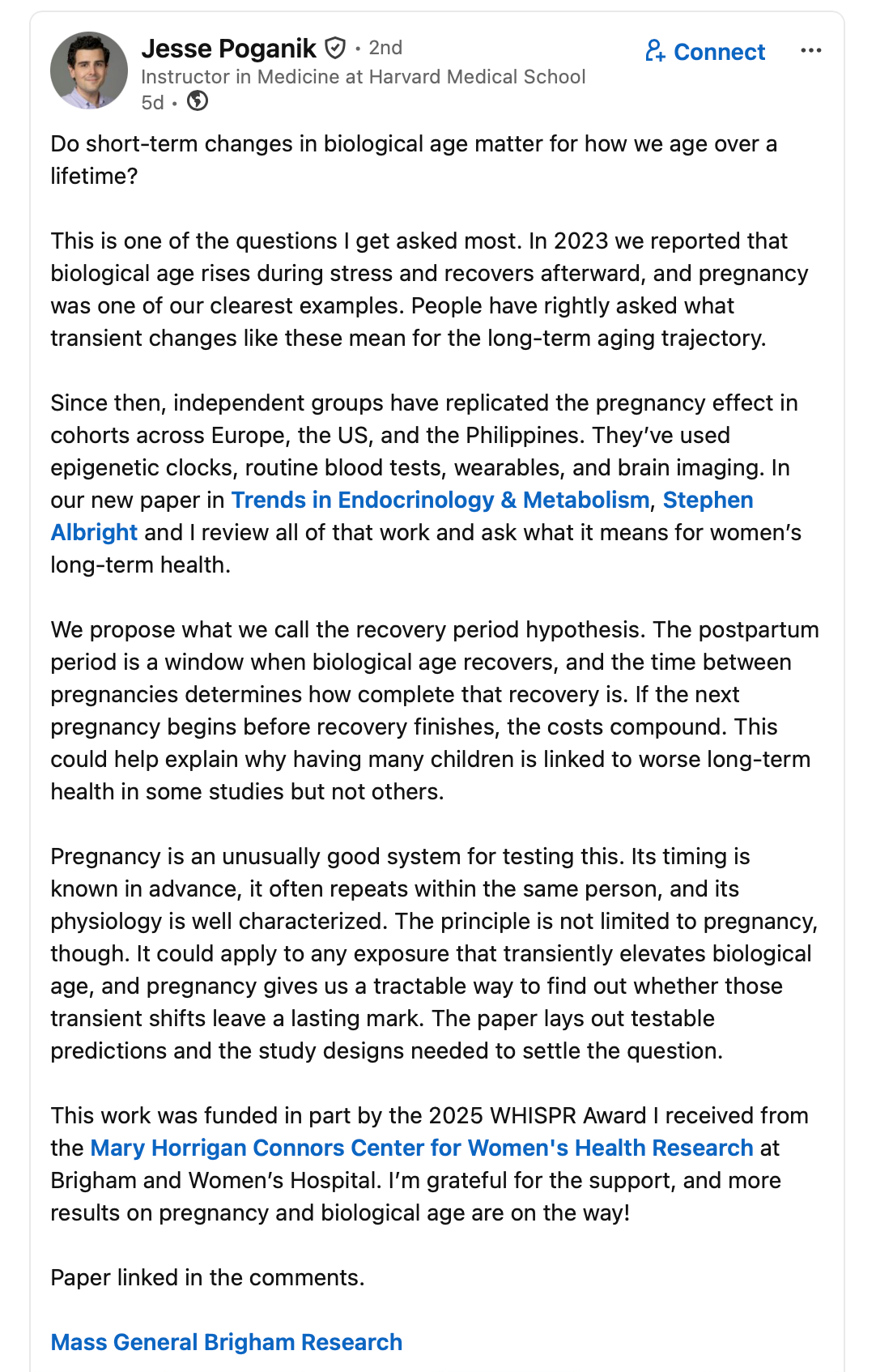
In another public post supplied with this article, Poganik describes the recovery-period hypothesis and states that costs compound if another pregnancy begins before recovery finishes. Later in the same post, he says the studies needed to determine whether transient shifts leave a lasting mark still need to be conducted.
That leaves the same question: what establishes the aging interpretation before its lasting consequences have been demonstrated?
Pregnancy care and longevity marketing need an evidence boundary
The screenshots show Poganik promoting coverage by Longevity.Technology, institutional research publicity, and a Cell Press post. They document a route by which the interpretation gains visibility and authority beyond the original papers.
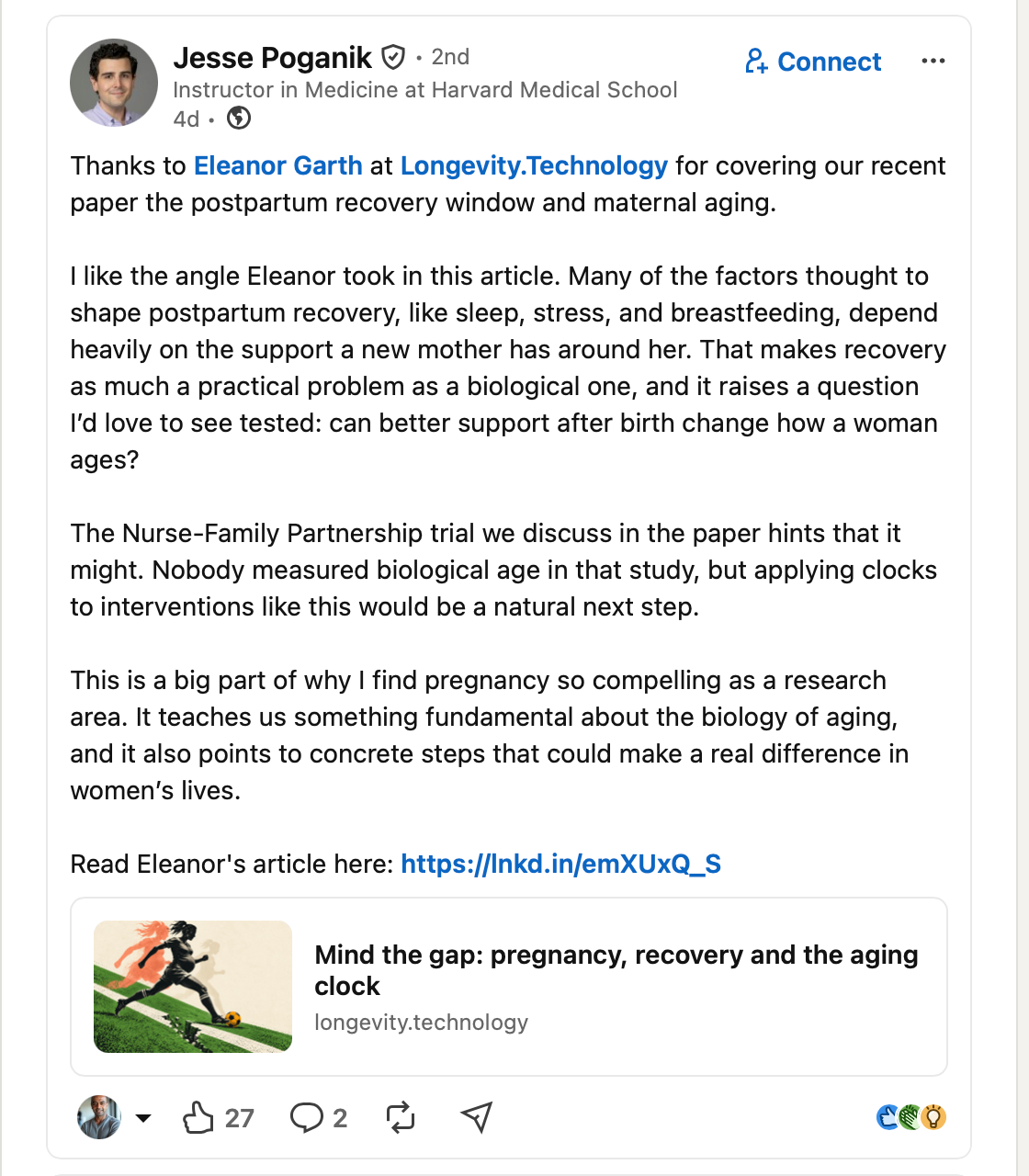
That visibility creates a responsibility for pregnancy specialists, longevity practitioners, and clinics that might repeat the claim.
If you tell a woman that pregnancy has accelerated her aging, what exactly have you measured to prove that? If you offer a test to assess whether she has recovered biologically, what validates its interpretation during pregnancy and postpartum? If you sell an intervention to reverse that supposed aging, what evidence establishes the condition you claim to treat?
Harvard's name cannot answer those questions.
Postpartum support has value without an aging narrative. Adequate recovery, nutrition, sleep, and appropriate clinical care do not need to be marketed through an unproven claim that motherhood has made a woman biologically older.
Any clinic making that transition should be required to show its evidence.
Harvard should explain what scrutiny occurred
When I completed my PhD in 1986, I experienced senior academic scrutiny as a real constraint on what I could responsibly claim. My professors could stop an argument that ran ahead of its evidence. Their names and the institution's reputation carried obligations.
I would not have expected to publish an interpretation this consequential without being pressed to demonstrate the link between the measurement and the conclusion.
I cannot tell readers what internal review occurred at Harvard Medical School or Brigham and Women's Hospital in this case. That information is not established by the material examined here.
But I can ask what their review was designed to catch, and whether it addressed the exact problem our paper identifies.
Who at Harvard Medical examined the pregnancy-specific validity of the aging interpretation? Who at Harvard Medical checked the evidentiary strength of the subsequent-pregnancy argument? Who at Harvard Medical reviewed the public wording? Who at Harvard Medical is responsible for ensuring that institutional publicity communicates the same uncertainty acknowledged in the scientific discussion?
Mass General Brigham's published spotlight makes this an institutional communication issue as well as an individual researcher's interpretation.
The questions that require a public answer
I am asking Harvard Medical School, Mass General Brigham, the authors, and the relevant journal editors to address five questions:
- What independently demonstrates that the pregnancy-related biomarker changes represent biological aging rather than a transient physiological adaptation?
- How could the three nonsignificant corresponding interactions in Etzel's study not have negated the cumulative-aging narrative?
- Can independent analysts obtain the identifiers, exposure mapping, preprocessing details, and analysis-ready data necessary to reproduce the central DunedinPACE interaction?
- What evidence supports any claim that a second pregnancy produces permanent or irreversible biological aging?
- Will public-facing communications consistently distinguish observed clock changes, proposed mechanisms, and demonstrated long-term outcomes?
Our paper and derived analysis are available for examination. The response should address the evidence directly.
Women deserve clear explanations of what research has measured and what remains unproven. They should not have to decode the difference between a scientific qualification and an authoritative headline.
Sources
[1] Weng K, Joseph B. Pregnancy-Associated Biomarker Changes Are Not Equivalent to Biological Aging. Journal of Human Science & Technology. Published October 26, 2026. https://www.journalhst.org/pregnancy-biomarker-changes-not-biological-aging/ . Paper and accompanying analysis: https://doi.org/10.5281/zenodo.23630711
[2] Etzel L, et al. Maternal biological aging from pregnancy through four years postpartum with disrupted recovery by subsequent pregnancy. iScience. 2026;29:116546. https://doi.org/10.1016/j.isci.2026.116546
[3] Gladyshev Lab team page. https://gladyshevlab.bwh.harvard.edu/team
[4] Poganik JR, et al. Biological age is increased by stress and restored upon recovery. Cell Metabolism. 2023;35:807–820.e5. https://doi.org/10.1016/j.cmet.2023.03.015
[5] Poganik JR, et al. Aging vs. biological age: Conceptual considerations for age reversal claims. Cell Metabolism. 2026;38:1746–1750. https://doi.org/10.1016/j.cmet.2026.06.015
[6] Albright SM, Poganik JR. The postpartum recovery window as a determinant of maternal aging. Trends in Endocrinology & Metabolism. Published online October 22, 2026. https://doi.org/10.1016/j.tem.2026.09.002
[7] Mass General Brigham. Research Spotlight on the postpartum recovery window. https://news.massgeneralbrigham.org/en/postpartum-recovery-window-may-play-a-critical-role-in-maternal-aging
[8] Cell Press news release, reproduced by Scimex. Giving birth again too soon after having a baby could lead to quicker biological aging. October 22, 2026. https://www.scimex.org/newsfeed/having-babies-back-to-back-may-affect-how-the-body-ages
Public-communication evidence also includes the Poganik and Cell Press LinkedIn screenshots supplied for this article. The quoted LinkedIn wording is transcribed from that material.