
FITNESS IS NOT HEALTH
Why Measuring Health Matters More
By Dr. Bomi Joseph
We have become very good at measuring fitness.
We can measure how fast you run.
How much weight you can lift.
How far you can cycle.
Your VO₂ max.
Your grip strength.
Your body-fat percentage.
Your resting heart rate.
Your recovery after exercise.
Entire industries have been built around these measurements.
And there is nothing wrong with them.
That distinction sounds obvious.
It isn’t.
In fact, I think it is one of the most important misunderstandings in modern health.
Fitness Is Performance
Fitness is essentially the ability to perform a particular physical task.
Can you run a mile quickly?
Can you lift a heavy object?
Can your cardiovascular system support sustained exercise?
Can your muscles generate power?
Can you recover from a workout?
These are useful questions.
But they are questions about performance.
A highly trained athlete may perform extraordinarily well while important parts of his or her physiology are functioning poorly.
Very fit people become seriously ill. Some die prematurely.
Conversely, people who have never entered a gym may live long, healthy lives with remarkably robust physiological function.
That is because:
Fitness is one component of health. It is not health itself.
The two frequently overlap.
They are not synonymous.
Then What Is Health?
This is where the problem begins.
Ask someone to measure fitness, and we have dozens of established tests.
Ask someone to measure health, and suddenly we start measuring other things.
Blood glucose.
HbA1c.
Cholesterol.
Triglycerides.
Liver enzymes.
Kidney function.
Hormones.
Inflammatory markers.
Blood pressure.
Body composition.
Bone density.
Heart rate.
Sleep.
The list can become enormous.
All of these measurements may tell us something useful about the body.
But none of them, individually, is health.
They are measurements of components participating in health.
That is a very different thing.
A fasting glucose measurement tells us about glucose regulation at one moment.
A hormone level tells us about one component of an endocrine system.
A comprehensive metabolic panel examines several chemical variables.
A blood count gives information about circulating cells.
These measurements can help identify abnormalities and disease.
They can help physicians understand physiology.
They are important.
But adding more measurements does not automatically create a measurement of health.
You can measure 10 variables.
Or 100.
Or 10,000.
You still have a collection of variables.
You have not necessarily measured the underlying property we call health.
The Human Body Is Not a Collection of Independent Numbers
This is another reason the subject becomes confusing.
The body does not operate as a spreadsheet.
Glucose does not function independently of insulin.
Insulin does not function independently of glucagon.
Hormones do not operate independently of the nervous system.
The nervous system does not operate independently of circulation.
Metabolism does not operate independently of immune function.
Muscle does not operate independently of bone.
And none of these systems functions independently of the environment.
The human organism contains an extraordinary network of sensors, receptors, signaling mechanisms, feedback loops, and effector systems.
A change in one place can generate responses across many different pathways.
The important biological event is therefore often not the absolute value of a single variable.
It is:
Did the body detect the change?
Did it generate an appropriate response?
How efficiently did it respond?
How quickly did it recover?
That is much closer to what I mean by health.
Health Is Capacity
For many years, I have defined health differently:
That definition changes the question completely.
Instead of asking:
“What is your glucose?”
We begin asking:
“How effectively does your system regulate glucose when challenged?”
Instead of simply asking:
“What is your resting heart rate?”
We ask:
“How appropriately does your cardiovascular system respond when demand changes, and how efficiently does it recover?”
Instead of:
“What is your cortisol?”
The more interesting question becomes:
“Can the organism mount the appropriate stress response and then shut it down when it is no longer required?”
Health is therefore not simply a collection of resting measurements.
It is the capacity of the organism to adapt.
And adaptation is dynamic.
A Healthy Body Is Constantly Moving
This is another misconception created by laboratory medicine.
We often imagine that health means keeping every biological variable at some perfect value.
That is not how a living organism works.
Healthy physiology moves.
Blood glucose rises and falls.
Heart rate accelerates and slows.
Blood vessels constrict and dilate.
Hormones rise and fall.
Temperature changes.
Immune activity increases and decreases.
Metabolic pathways accelerate, decelerate, and change direction.
The objective is not biological stillness.
Stillness is not life.
The objective is appropriate regulation.
A healthy system detects a disturbance, responds proportionately, and returns efficiently toward its functional state.
That ability is very different from having a laboratory result inside a reference interval.
Normal Is Not the Same as Healthy
This is why a person can have a page of apparently normal laboratory results and still not be particularly healthy.
The laboratory may simply have measured the system while it was sitting quietly.
Imagine examining a Formula One car parked in the garage.
The tire pressure is correct.
The fuel level is correct.
The coolant temperature is normal.
The battery voltage is normal.
Excellent.
But we still don’t know how the car performs when the accelerator is pressed.
Biological systems reveal enormous amounts of information when they are challenged.
That is when we see the ability to detect, respond, and recover.
Why Fitness Can Be Misleading
Fitness testing usually involves challenge, which is one reason it can be very informative.
But fitness tests challenge a relatively narrow part of physiology.
A marathon runner may have exceptional cardiovascular endurance.
A powerlifter may have extraordinary muscular strength.
A gymnast may have remarkable neuromuscular control.
Those are impressive capabilities.
But they do not tell us everything about the health of the organism.
The mistake occurs when we take excellence in one physiological domain and extrapolate it to the entire human system.
That would be like measuring the horsepower of a car and concluding that the transmission, brakes, electronics, cooling system, and suspension must therefore also be excellent.
They may be.
But horsepower did not measure them.
Similarly:
Fitness tells us something important about a human being.
It does not tell us everything important about that human being.
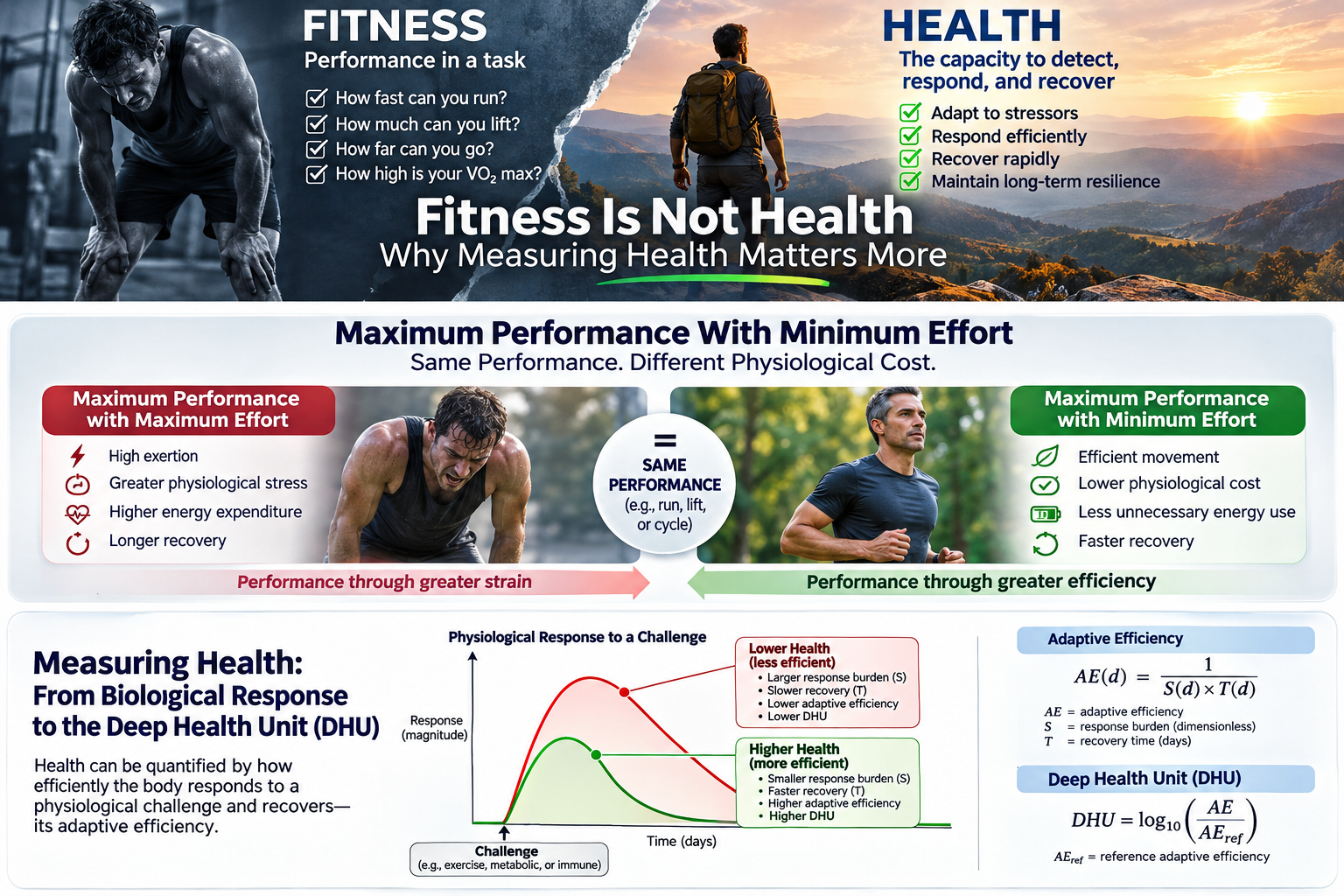
Maximum Performance With Minimum Effort: Where Fitness Meets Health
I have practiced martial arts for most of my life.
As an eighth-degree black belt in Kyokushin Karate, I have spent decades studying not only physical performance, but also the efficiency of movement, response, and recovery.
And my philosophy of physical performance has always been simple:
Notice that I did not say maximum performance with maximum effort.
Anyone can attempt to improve performance by working harder, pushing longer, increasing the load, or demanding more from the body.
That is what much of the fitness industry encourages.
More repetitions.
More intensity.
More exertion.
More exhaustion.
And when performance improves, we celebrate.
But I have always been interested in a different question:
How little effort does the organism require to produce that performance?
This is the distinction between brute output and biological efficiency.
Consider two individuals who accomplish exactly the same physical task.
One requires enormous exertion, experiences substantial physiological stress, and takes a long time to recover.
The other accomplishes the same task smoothly, efficiently, with less physiological disturbance, and recovers rapidly.
Their measured fitness performance may be identical.
Their physiological efficiency is not.
This is where fitness begins to connect with health.
In martial arts, the most accomplished practitioner is not necessarily the one who generates the greatest visible effort.
It is often the one who produces the desired result with the least unnecessary movement, muscular tension, and expenditure of energy.
The movement becomes economical.
The response becomes precise.
The recovery becomes rapid.
The entire organism becomes coordinated.
That is my philosophy of fitness.
And that is also the foundation of my approach to health.
Fitness measures the performance. Health measures the biological capacity supporting that performance.
When we pursue maximum performance through minimum necessary effort, we are no longer training simply for greater output.
We are training for efficiency.
We are bringing fitness into alignment with health.
And there is a profound difference between the two.
The objective is not to avoid difficult training. Challenging the body is often necessary to develop greater capability.
The objective is to reduce the unnecessary physiological cost of achieving that capability.
The objective is to become more capable without unnecessarily exhausting it.
That is the difference between simply getting fitter and developing fitness in a way that supports health.
The Fitness Question and the Health Question
This distinction can be expressed very simply.
FITNESS ASKS:
How much can you do?
HEALTH ASKS:
How efficiently can you do it, and how rapidly can you recover?
That is the connection between fitness and health.
Performance alone is not enough.
What matters is the biological efficiency with which that performance is achieved.
The Three Things We Keep Confusing
I would separate modern health measurements into three categories:
| What We Measure | What It Tells Us | What It Does Not Necessarily Tell Us |
|---|---|---|
| Fitness | Physical performance and capacity in selected tasks | Overall physiological health |
| Biomarkers | The state of particular biological components | How the entire system functions together |
| Health | Integrated capacity to detect, respond, and recover | It cannot be reduced to one isolated biomarker |
This distinction matters enormously.
Because if we confuse the measurement, we confuse the objective.
Someone can improve a biomarker without necessarily improving the entire organism.
Someone can improve athletic performance without necessarily improving health.
And someone can improve health without becoming an athlete.
Health Had Another Problem: It Had No Unit
There was an additional problem that bothered me for decades.
We talked constantly about health.
Good health.
Poor health.
Better health.
Declining health.
Improving health.
But what exactly was the unit?
Consider weight.
“He is heavy” is a description.
But once I put someone on a scale and say he weighs 82 kilograms, weight becomes quantitatively useful.
Temperature is another concept.
“This person feels hot” is qualitative.
38.5°C is a measurement.
Distance became measurable because we agreed upon units.
Time became measurable because we agreed upon units.
Electrical current has amperes.
Force has newtons.
Energy has joules.
Yet one of the most important properties of human existence — health — remained largely descriptive.
We could measure thousands of things associated with health.
But we did not have a unit for health itself.
That is the problem we set out to solve.
The Deep Health Unit (DHU)
We developed the Deep Health Unit (DHU) as a way of expressing health quantitatively.
The important conceptual shift was this:
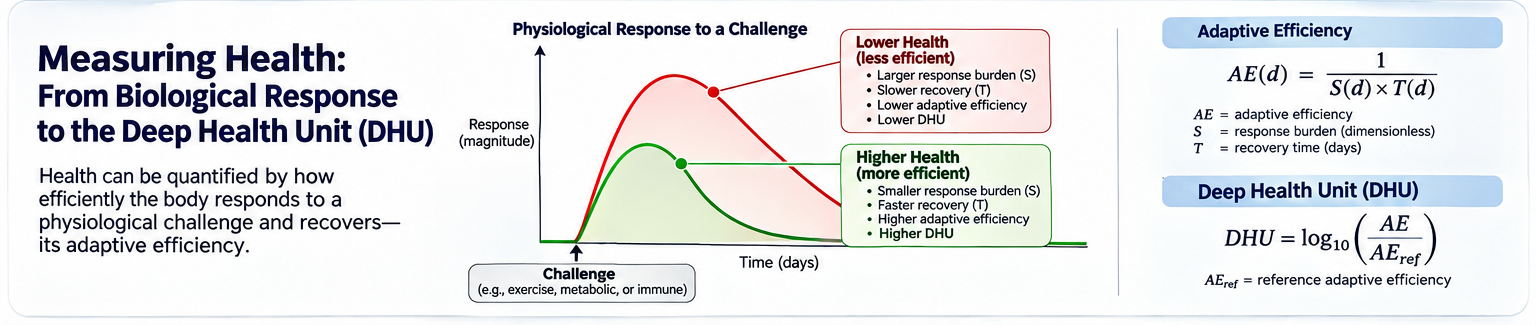
Our research examined how biological systems respond to challenges, how rapidly they recover, and how efficiently they coordinate these responses.
The underlying principle is that health is reflected in the organism’s adaptive capacity.
Our foundational research incorporated immune-response dynamics, metabolic measurements, and recovery kinetics.
These investigations led to the development of a quantitative framework based on adaptive efficiency.
At its simplest, the approach relates the magnitude and timing of biological responses and recovery to an adaptive-efficiency measure.
The Deep Health Unit expresses this efficiency relative to a defined reference on a logarithmic scale.
In the foundational formulation:
Where:
AE represents adaptive efficiency.
S represents the dimensionless response burden defined by the measurement protocol.
T represents recovery time in days.
The Deep Health Unit is then defined as:
Where AEref is the specified reference adaptive efficiency.
The equation is not intended to suggest that every physiological process can be captured by one isolated variable.
It establishes a common quantitative framework for comparing biological adaptive efficiency under defined conditions.
The important distinction is this:
We are no longer simply collecting measurements of individual biological components.
We are attempting to quantify how efficiently the organism responds to physiological demand and recovers from it.
This approach connects directly with my philosophy of maximum performance with minimum effort.
A biological system that performs its functions efficiently, responds appropriately to stress, and recovers rapidly is demonstrating the qualities we associate with health.
This is what the DHU was developed to quantify.
For readers interested in the scientific foundations, our research is described in the Journal of Human Science & Technology:
Health Is an Emergent Property
The easiest way to understand this may be to think of health as an emergent property.
A human being is composed of organs.
Organs are composed of tissues.
Tissues are composed of cells.
Cells contain extraordinarily complicated biochemical machinery.
But health does not reside inside any one of them.
Health emerges from their coordinated function.
Just as consciousness cannot be determined by measuring the sodium concentration of one neuron, the health of a human being cannot be determined by examining one molecule in the blood.
The important information lies in the relationships.
The communication.
The regulation.
The timing.
The feedback.
The response.
The recovery.
This is why measuring health is fundamentally a systems-biology problem.
Disease Medicine and Health Measurement Are Different Questions
Modern medicine is extraordinarily good at finding disease.
That is what much of medical testing was designed to do.
Is the kidney failing?
Is glucose regulation abnormal?
Is there anemia?
Is there infection?
Is there liver damage?
Is there cardiovascular disease?
These are critically important questions.
But:
The absence of detectable disease is not a quantitative measurement of health.
Those are different questions.
Disease asks: What is broken?
Health asks: How capable is the system?
One looks primarily for pathology.
The other measures adaptive capacity.
We need both.
Why Measuring Health Matters
Once health can be measured quantitatively, the objective changes.
Instead of merely trying to avoid disease, we can ask whether the biological system itself is becoming more or less capable.
Instead of asking whether one biomarker improved, we can ask whether the organism improved.
Instead of assuming that greater fitness automatically means greater health, we can measure them independently.
And perhaps most importantly, we can begin following health longitudinally.
Not simply:
“Did I lose weight?”
Or:
“Did my VO₂ max improve?”
Or:
“Did my glucose fall?”
But:
That is a much more important question.
And it is the question that motivated much of my life’s research.
Fitness Matters. But Health Matters More.
I am not arguing against fitness.
Quite the opposite.
Physical capacity is enormously valuable.
Strength matters.
Mobility matters.
Cardiovascular capacity matters.
Muscle matters.
Movement matters.
But none of those should be mistaken for the entirety of health.
My philosophy has always been to obtain maximum performance with minimum effort.
Because the real achievement is not simply how much force, speed, or endurance the body can generate.
It is how efficiently the entire organism can produce that performance, regulate the physiological demands it creates, and recover.
Fitness is something the body can do.
Biomarkers describe pieces of what the body contains or is doing at a particular moment.
Health describes the capacity of the entire organism to adapt.
That distinction is the foundation of Deep Health.
And until we begin making that distinction clearly, people will continue accumulating more and more health data while remaining uncertain about the simplest question of all:
That is the question we should have been measuring all along.
Dr. Bomi Joseph is a physician, health scientist, and inventor of the Deep Health® Device. His research focuses on quantifying human health through physiological adaptive capacity rather than relying exclusively on disease markers or physical performance.
Scientific reference: Measuring Human Health as Adaptive Biological Efficiency — Journal of Human Science & Technology